TL;DR: Friday’s 2.86% Nasdaq plunge and an 8.24% semiconductor-ETF drop extended a two-week AI-driven selloff that is now reaching corporate credit assessments — S&P Global cut Meta’s outlook to negative. With Gold, Silver and Bitcoin all falling alongside tech even as Treasury yields drop, Nasdaq’s 25,036.33, S&P 500’s 7,507.77 and the 10-year yield’s 4.815% are the critical tests for whether this becomes a broader correction.
Why This Matters
The sell-off in AI-related stocks is becoming harder to dismiss as another temporary setback. Three episodes of selling over the past two weeks have progressively weakened market sentiment, culminating in Friday’s 2.86% plunge in Nasdaq Composite and an 8.24% decline in the iShares Semiconductor ETF. More importantly, concerns about the financial returns from massive AI infrastructure spending are beginning to extend beyond equity valuations into corporate credit assessments.
The deterioration is also becoming visible across asset classes. Treasury yields have fallen sharply as markets scale back expectations for Fed tightening, while Gold, Silver and cryptocurrencies have come under renewed selling pressure. Yet the Dollar has held within its bullish consolidation, and S&P 500 has not suffered the same technical breakdown as Nasdaq.
The risk of a deeper, more persistent market correction has increased, but a generalized breakdown is not yet confirmed. The coming week could be particularly important, with US midterm elections and renewed Middle East tensions adding uncertainty to markets already questioning the sustainability of the AI investment boom.
AI Concerns Move Beyond Valuations Into Credit
The central concern has shifted from whether AI-related stocks are expensive to whether companies can generate sufficient returns to justify their enormous investment commitments.
Alphabet’s 12.64% plunge on Thursday highlighted that tension. Despite strong cloud revenue growth, the company reported negative quarterly free cash flow of $9.07B as capital expenditure reached $51.4B. Amazon subsequently added to investor concerns with disappointing earnings and continued heavy capital spending, while Intel’s weaker guidance intensified selling across semiconductor stocks.
The pressure became more pronounced on Friday:
- Nasdaq Composite: −2.86% to 25,437.00, its worst session since June
- S&P 500: −1.82% to 7,580.07
- iShares Semiconductor ETF: −8.24%, now ~29% below its previous high
- Intel: −28.58%, though company-specific operating problems also contributed
The broader message from the sector is that investors are becoming less willing to overlook the financial costs of AI expansion, even when the underlying demand outlook remains constructive.
The more significant development came from the credit market.
S&P Global Ratings revised Meta’s credit outlook from stable to negative, citing uncertainty surrounding elevated capital expenditure and future cash generation. Meta’s planned 2026 capital spending of $135B–$145B and its $2.12B quarterly free cash flow deficit have brought greater attention to how the company intends to finance and monetize its AI investments.
The rating itself was not downgraded, and Meta disputed the assessment. Nevertheless, the outlook revision shows that concerns about AI spending are beginning to influence judgments about corporate financial strength, not merely the prices investors are willing to pay for technology shares.
That distinction matters because a further deterioration in credit conditions could have consequences beyond a correction in richly valued stocks.
There are still important counterweights. US Q3 GDP expanded 3.4% annualized, while Microsoft Azure and Google Cloud continued reporting substantial revenue growth. Defensive sectors also showed resilience on Friday, and S&P 500 was still relatively close to its record despite Nasdaq’s sharper retreat.
The evidence therefore does not establish that the AI investment cycle is collapsing. Rather, the market is increasingly questioning whether the financial returns and funding arrangements behind that expansion can justify the scale of spending already committed.
Treasury Rally Reflects a More Cautious Fed Outlook
The technology sell-off has coincided with a substantial reassessment of US interest-rate expectations.
The Fed held its policy rate at 3.75–4.00% during the week, with two policymakers dissenting in favour of an increase. Chair Kevin Warsh avoided committing to a predetermined tightening path, leaving investors to reassess how much further the central bank could raise rates as financial-market conditions deteriorated.
The repricing has been substantial and consistent in direction:
- December hike probability: 89.5% a month ago → 76.2% a week ago → 70.7% as of Saturday
- 12-month implied tightening (OIS): 74.3bps on October 28 → ~55.5bps now — a reduction of almost a full quarter-point hike
Another increase remains the base case, but conviction has weakened.
Part of the reassessment reflects concern that sustained weakness in technology shares could tighten financial conditions and eventually weigh on economic activity. September’s headline PCE inflation of 3.6% was also slightly below the 3.7% expectation, although inflation remains elevated and the latest GDP figures continue to show economic resilience.
Treasury yields have adjusted accordingly. The 2-year yield closed around 4.594%, extending its decline from 4.960%, while the 10-year yield finished near 4.933%, substantially below its October peak of 5.365%.
The Treasury rally presents an important question that goes beyond Fed pricing.
Lower yields may reflect expectations for a shallower tightening cycle. They may also reflect investors seeking protection against a deterioration in equities, credit conditions and economic growth. Both influences could be operating simultaneously.
An orderly correction in yields would be consistent with markets adjusting to a less aggressive Fed outlook. A much deeper decline, particularly alongside worsening equity and credit conditions, would raise concerns that investors are preparing for more serious financial stress.
Dollar Holds Firm as Selling Spreads Across Risk Assets
The Dollar’s performance illustrates the conflicting forces now influencing markets.
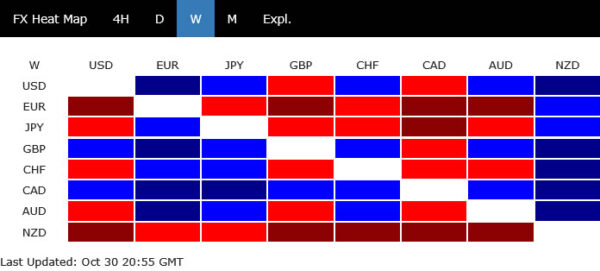
Dollar Index recovered from Friday’s earlier weakness to close at 101.963, gaining 0.11% on the day and approximately 0.39% over the week. The weekly FX heat map showed Canadian Dollar and Sterling among the strongest currencies, while New Zealand Dollar and Euro underperformed.
Lower Treasury yields and reduced Fed tightening expectations are weighing on the Dollar’s interest-rate advantage. At the same time, worsening risk appetite can support the currency through defensive demand and liquidity preferences. Neither influence has decisively prevailed, leaving the Dollar broadly range-bound despite significant volatility elsewhere.
The weakness in other assets is more pronounced:
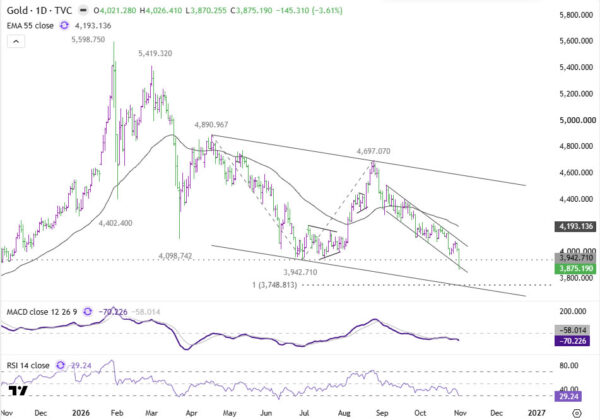
- Gold: −3.6% on Friday, to around 3,875
- Silver: −5.8%, to 49.11
- Bitcoin: ~77,300 in Saturday’s snapshot, well below its recent high near 87,354
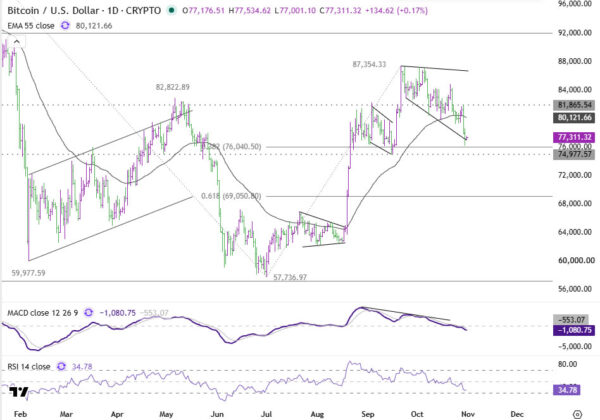
The simultaneous decline in technology equities, precious metals and cryptocurrencies is consistent with investors reducing exposure across volatile assets. However, it does not establish forced liquidation or a common selling mechanism. Positioning, open interest and fund-flow evidence would be needed before reaching that conclusion.
For now, the important development is that selling pressure has spread beyond AI-related equities, even though the broader financial system has not shown evidence of a generalized breakdown.
Midterms and Iran Add Two Different Risks for Next Week
Markets now face additional uncertainty from the November 3 US midterm elections and the possibility of renewed military confrontation involving Iran.
A Democratic takeover of the House has been widely anticipated in investor surveys, suggesting that such an outcome may already be partly reflected in market expectations. Greater surprises could come from the Senate result or uncertainty surrounding the vote count.
The geopolitical outlook carries a different set of risks. Reports that Washington has discussed preparations for a possible military campaign against Iran after the elections have raised concerns about further escalation. No final decision to launch an operation has been established, but the possibility matters because oil and European natural gas prices have already risen sharply.
A further energy-price shock could intensify inflation pressures precisely as financial markets are becoming more concerned about growth, creating two potentially competing risk-off scenarios: one driven by AI-related financial stress, the other by an exogenous geopolitical shock. Either alone would test markets that are already technically weakened; together, they could be the catalyst that determines whether the current selloff deepens into a broader and more sustained correction.