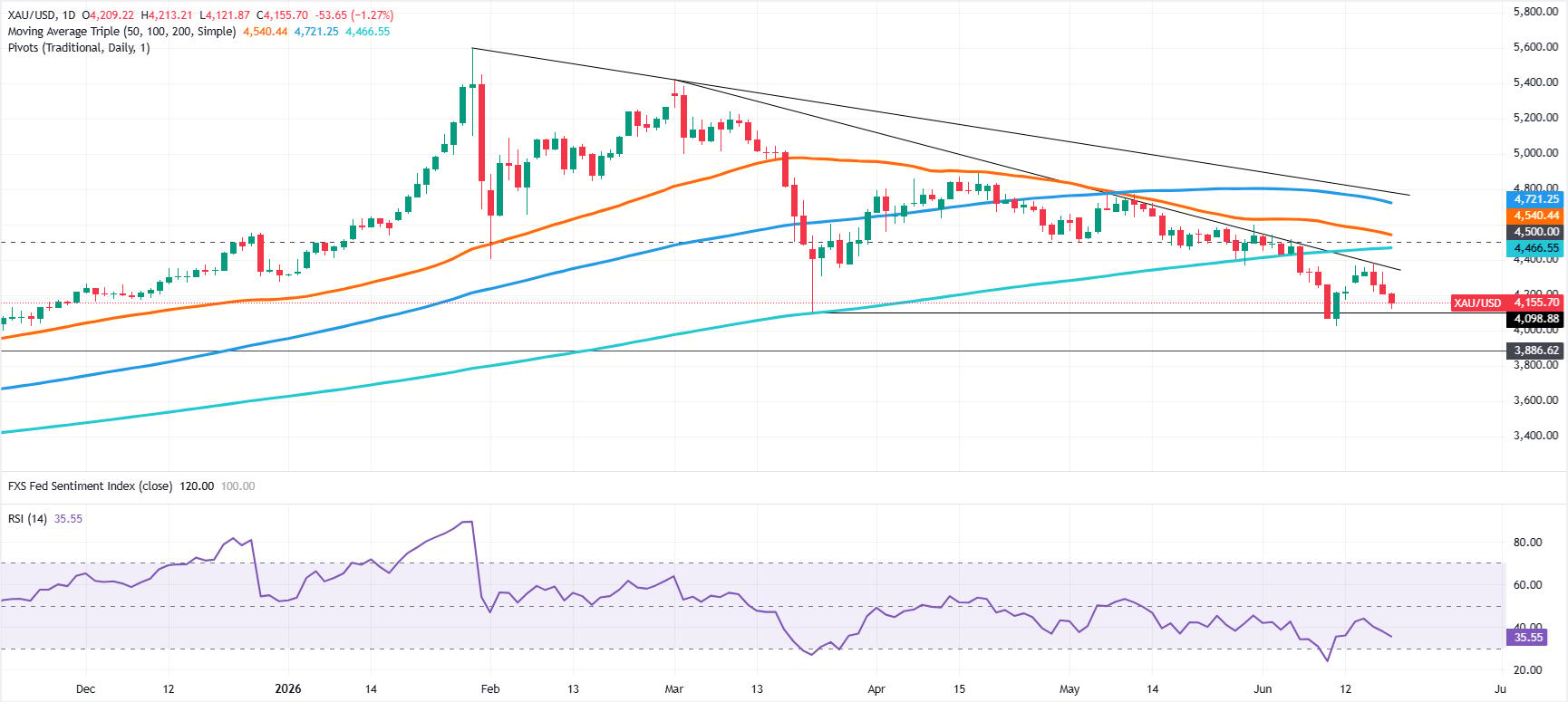
Gold (XAU/USD) price edges lower by some 1.69% on Friday, poised to end with losses for the third consecutive week. At the time of writing, XAU/USD trades at $4,147, weighed by overall US Dollar strength sparked by the Federal Reserve’s (Fed) decision to keep interest rates higher for longer.
XAU/USD Falls as Dollar Strength and Rising US Yields Bite
A risk-on mood is weighing on non-yielding metals, as investors turn to US Treasuries, which pay a yield, and the US Dollar, which is at 13-month highs above 101.00, as depicted by the US Dollar Index (DXY).
The US-Iran deal shifted traders’ sentiment, though it remains fragile as Israel and Hezbollah exchanged strikes before newswires reported that both sides favor a ceasefire, adhering to the deal signed by Washington and Tehran. Nevertheless, the Washington Post revealed that US intelligence warned the Trump administration that Israel’s Prime Minister Benjamin Netanyahu could take steps to “sabotage” the deal as he faces political pressure.
The reopening of the Strait of Hormuz alleviated oil supply disruptions, easing inflationary pressures. However, some major central banks have taken steps to tame inflation, with the European Central Bank (ECB) hiking rates by 25 basis points on June 11, followed by the Bank of Japan (BoJ) on Tuesday.
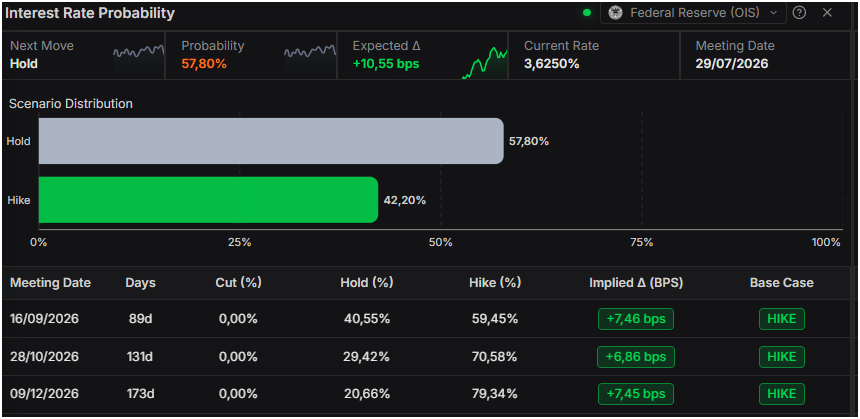
Adding its name to the list could be the Federal Reserve, which, at its last meeting, hinted that nearly half of the FOMC board members are eyeing at least one rate hike in 2026.
US Treasury yields are rising sharply, with the 2-year T-note — the most sensitive to market expectations of rate hikes — rising 13 basis points after the Fed’s meeting, driving Gold prices toward six-day lows of $4,121.
Prime Terminal data showed that money markets are pricing in 18 basis points of Fed tightening at the September 16 meeting, implying a 72% chance of a rate hike.
The US investment bank Goldman Sachs cut its Gold price forecast to $4,900 per troy ounce by December, $500 less than its previous estimates.
Investors’ eyes are on next week’s US economic docket, mainly the Gross Domestic Product (GDP) figures for Q1 2026 — the final estimate — along with the Core Personal Consumption Expenditures (PCE) Price Index, the Fed’s preferred inflation gauge.
XAU/USD Technical Outlook: Gold’s Downtrend to Continue Below 200-Day SMA
Gold remains biased downward after dropping below the 200-day Simple Moving Average (SMA) at $4,466. Price action depicts a series of lower highs and lower lows, though a decisive break below $4,100 would clear the way to challenge the current year-to-date (YTD) low of $4,023, set on June 11.
Momentum remains bearish as depicted by the Relative Strength Index (RSI), whose slope points downward with room to spare before reaching oversold territory.
If XAU/USD dives below $4,100, the $4,000 level comes into play. Below that, the yellow metal’s next target is the October 28, 2025 swing low of $3,886.
On the bullish side, Gold must reclaim the June 17 cycle high of $4,382. Once cleared, buyers would need to overcome the 200-day SMA. If those levels are taken, $4,500 emerges as the next area of interest.
Gold FAQs
What role does Gold play as an asset? Gold has played a key role in human history as a widely used store of value and medium of exchange. Apart from its shine and usage in jewelry, the precious metal is widely seen as a safe-haven asset, considered a good investment during turbulent times. Gold is also widely seen as a hedge against inflation and depreciating currencies, as it doesn’t rely on any specific issuer or government.
Why do central banks buy Gold? Central banks are the biggest Gold holders. In their aim to support their currencies in turbulent times, central banks tend to diversify their reserves and buy Gold to improve the perceived strength of the economy and the currency. High Gold reserves can be a source of trust for a country’s solvency. Central banks added 1,136 tonnes of Gold worth around $70 billion to their reserves in 2022, according to data from the World Gold Council — the highest yearly purchase since records began. Central banks from emerging economies such as China, India, and Turkey are quickly increasing their Gold reserves.
How does Gold correlate with the Dollar and Treasuries? Gold has an inverse correlation with the US Dollar and US Treasuries, which are both major reserve and safe-haven assets. When the Dollar depreciates, Gold tends to rise, enabling investors and central banks to diversify their assets in turbulent times. Gold is also inversely correlated with risk assets. A rally in the stock market tends to weaken Gold price, while sell-offs in riskier markets tend to favor the precious metal.
What factors drive the price of Gold? The price can move due to a wide range of factors. Geopolitical instability or fears of a deep recession can quickly push Gold prices higher due to its safe-haven status. As a yield-less asset, Gold tends to rise with lower interest rates, while higher borrowing costs usually weigh on the metal. Most moves, however, depend on how the US Dollar behaves, as Gold is priced in dollars (XAU/USD). A strong Dollar tends to keep Gold prices in check, whereas a weaker Dollar is likely to push them higher.