The North American employment picture received a significant boost as both the United States and Canada delivered much stronger-than-expected labor market reports, reinforcing the view that economic activity remains resilient despite concerns about slowing growth and elevated interest rates.
US Nonfarm Payrolls
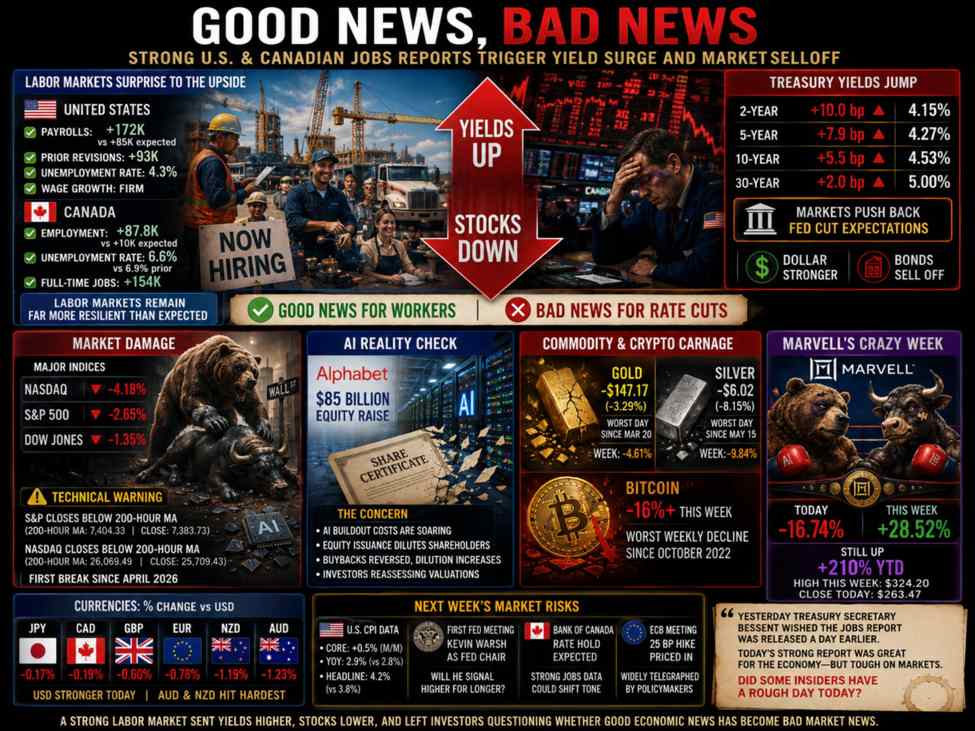
In the United States, nonfarm payrolls increased by 172,000 in May, nearly double the consensus estimate of 85,000. Adding to the strength, prior months were revised higher by a combined 93,000 jobs, while the unemployment rate held steady at 4.3% and wage growth remained firm. The report suggested that hiring momentum remains intact and reduced expectations that the Federal Reserve will be in a position to ease policy anytime soon. Treasury yields surged following the release, the U.S. dollar strengthened, and equity markets came under pressure as investors repriced the outlook for interest rates.
Canada Labor Market
Canada’s labor market also surprised to the upside. Employment rose by 87,800 jobs versus expectations for a gain of just 10,000, while the unemployment rate fell sharply to 6.6% from 6.9%. The strength was particularly encouraging because it was driven by a surge of 154,000 full-time jobs, offsetting weakness seen earlier in the year. Job gains were broad-based, led by construction, transportation and warehousing, accommodation and food services, information and recreation, and manufacturing. The primary area of weakness remained wholesale and retail trade.
Taken together, the reports painted a picture of two labor markets that remain far more resilient than expected. That is the good news.
The not-so-good news for policymakers is that the stronger employment data reduces pressure for additional monetary easing. In the U.S., markets pushed Treasury yields higher and increased expectations that the Federal Reserve will keep rates elevated for longer - and perhaps raise rates toward the end of the year, which would be a significant reversal from just a few months ago. In Canada, the report reinforced expectations that the Bank of Canada may remain on hold after its recent easing cycle. Currency markets reflected the stronger Canadian data, with USDCAD moving modestly lower following the release, although gains in the U.S. dollar from the stronger U.S. report limited the downside.
Treasury Yields
The stronger-than-expected U.S. jobs report sparked a sharp selloff in the Treasury market as traders reduced expectations for near-term Federal Reserve rate cuts. The move was led by the front end of the yield curve, reflecting a repricing of Fed policy expectations. The 2-year Treasury yield climbed 10.0 basis points to 4.15%, while the 5-year yield rose 7.9 basis points to 4.268%. Longer-term yields also moved higher, with the benchmark 10-year yield increasing 5.5 basis points to 4.530% and the 30-year bond yield advancing 2.0 basis points to 4.996%. The steeper rise in shorter-dated yields highlighted the market’s view that a resilient labor market and still-elevated inflation pressures could keep the Federal Reserve on hold for longer than previously anticipated.
Equity Markets
Stocks were mixed to start the day, with the Dow higher and the S&P and Nasdaq lower - the Nasdaq was down about 300 points going into the jobs report. The jobs report sent stocks lower on the back of rising yields. Concerns about the week’s events were compounded by Alphabet floating $85 billion of equity, a reminder that AI is going to cost a lot and that cost is now eating into shareholder value as equity gets diluted. In the past, stock owners benefited from buybacks of shares reversing dilution. Now, with the number of shares increasing, that dynamic is reversing.
The declines accelerated, with both the S&P and Nasdaq indices closing below their 200-hour moving averages for the first time since April 2026. For the S&P, the 200-hour moving average comes in at 7,404.33, against a closing price of 7,383.73. For the Nasdaq, the 200-hour moving average stands at 26,069.49, with a closing price well below that level at 25,709.43.
There were a number of individual stocks that fell more than 10% on the day.
In a unique week, Marvell Technology was one of the worst performers on the day with a decline of -16.74%, but one of the best performers for the week with a gain of 28.52%. Its stock is still up 210% for the year. The share price reached $324.20 earlier in the week before closing at $263.47.
FX: Major Currency Losses vs. USD
The USD was stronger on the day, with the AUD and NZD the hardest hit against the greenback. Ranking major currency losses versus the dollar:
- JPY -0.17%
- CAD -0.19%
- GBP -0.60%
- EUR -0.78%
- NZD -1.19%
- AUD -1.23%
Commodities and Crypto
The price of gold reacted negatively to higher yields and a stronger dollar:
- Gold tumbled $147.17 or -3.29%, its worst day since March 20. For the week, the price fell -4.61%.
- Silver fell $6.02 or -8.15%, its worst day since May 15. For the week, the price fell -9.84%.
- Bitcoin continued its move to the downside, falling more than 16% for the week - its worst one-week percentage decline since October 2022.
Looking Ahead
Recall from yesterday: Treasury Secretary Bessent remarked that he wished the employment report had been released a day earlier. While he denied having any advance knowledge of the numbers, the comment looks particularly interesting in hindsight.
Ironically, what would normally be considered good news for the economy turned out to be bad news for the market. The stronger-than-expected jobs report sent Treasury yields sharply higher as investors reassessed the likelihood of near-term Fed rate cuts. The result was a broad stock market selloff, with high-flying technology and AI shares leading the decline.
It raises an interesting question: did some insiders have a rough day today?
Markets will next prepare for Kevin Warsh’s first meeting as Fed chair. Before then, CPI data will be released next week, with expectations for a core gain of 0.5% month-on-month and the year-on-year rate rising to 2.9% from 2.8%. The headline figure is expected to reach 4.2% from 3.8% the prior month.
The Bank of Canada is expected to keep rates unchanged, but with the strong jobs report it will be interesting to see if there is any shift in tone. The ECB will also meet, and the market has priced in a 25 basis point hike - a move that has been well telegraphed by policymakers.