US Treasury yields skyrocketed across the whole curve on Friday, with the 2-year Treasury note yield rising over 12 basis points, while the benchmark 10-year note surged six basis points following an outstanding Nonfarm Payrolls report.
Treasury Yields Surge After Payrolls Crush Forecasts, Lifting Dollar
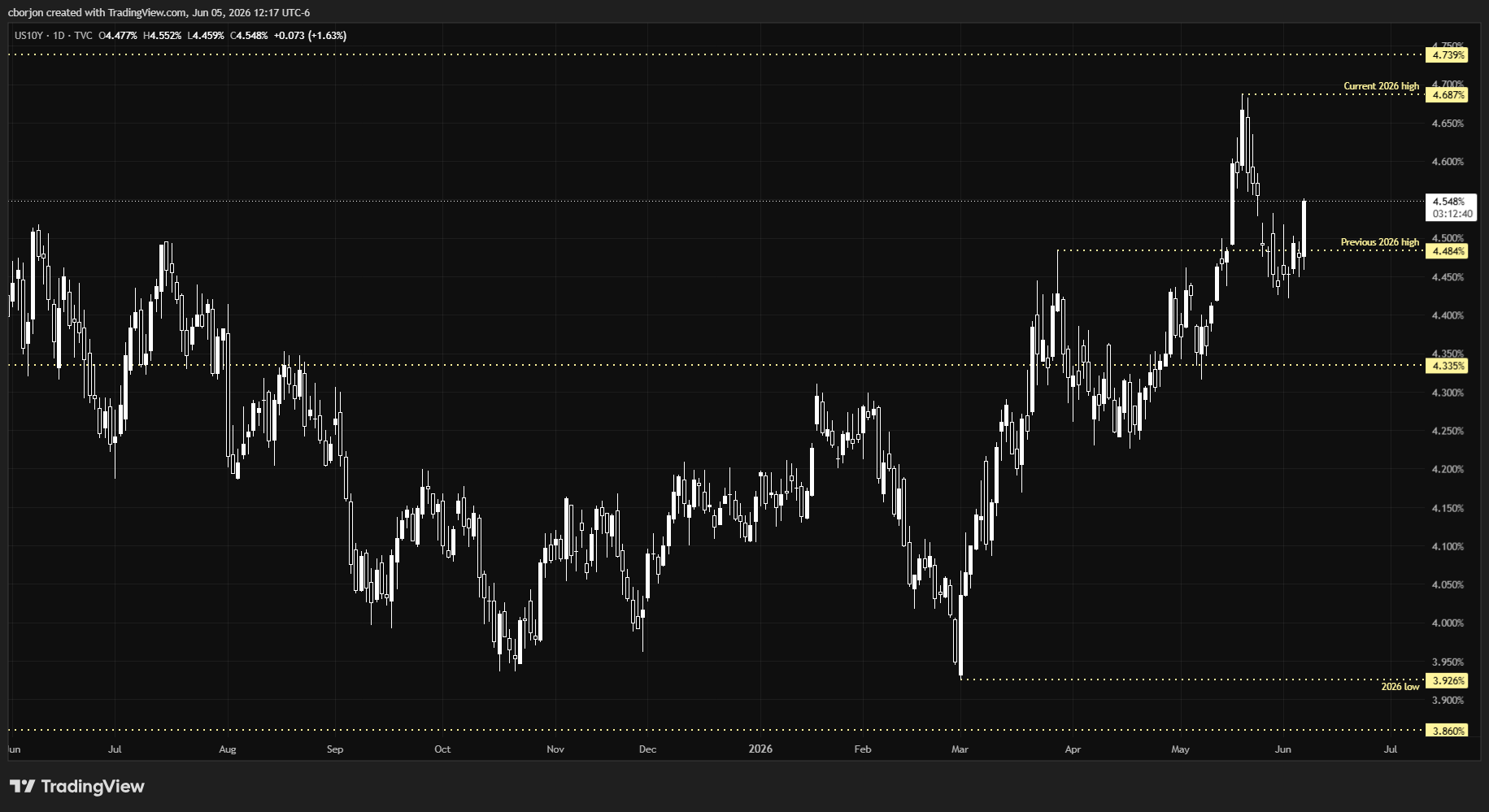
At the time of writing, the US 2-year Treasury note yields 4.162%, while the 10-year yield is at 4.538%. This signals that traders are expecting the Federal Reserve (Fed) to raise interest rates, spurred by high US inflation, with the latest Consumer Price Index (CPI) report showing prices rose 3.8% in April.
The stellar May Nonfarm Payrolls report showed the strength of the labor market, with the economy adding 172,000 workers - well above estimates of 85,000. The Unemployment Rate held steady at 4.3% for the third consecutive month, providing ammunition for Federal Reserve hawks to discuss whether to tighten monetary policy this year, after easing policy by 75 basis points in the second half of 2025.
Cleveland Fed President Beth Hammack - the most hawkish member of the Fed and a voter in 2026 - stated that it is “reasonable to keep rates steady for now, but if recent trends persist, it might soon be necessary to act against high inflation.”
Based on Prime Terminal data, there is a 67% chance the Federal Reserve will hike rates in December, and markets have fully priced in a 25 bps increase for early 2027.
The US Dollar Index (DXY), which measures the dollar’s value against six currencies, jumped 0.67% to 100.09 after bouncing from daily lows around 99.15.
Meanwhile, US financial markets’ five-year inflation expectations stand at 2.48%, down from 2.53% the previous day, according to the 5-year Breakeven Inflation Rate. The 10-year Breakeven Rate fell from 2.38% to 2.36%, suggesting markets expect medium-term inflation to decline.
Upcoming US Economic Events for Next Week
The US economic calendar will include inflation reports for both consumer and producer prices, along with jobless claims data. Federal Reserve officials will be in their blackout period ahead of the June 16–17 meeting - the first chaired by new Fed Chair Kevin Warsh.
US 10-Year Treasury Note Yield
Interest Rates FAQs
What are interest rates? Interest rates are charged by financial institutions on loans to borrowers and are paid as interest to savers and depositors. They are influenced by base lending rates, which are set by central banks in response to changes in the economy. Central banks normally have a mandate to ensure price stability, which in most cases means targeting a core inflation rate of around 2%. If inflation falls below target, the central bank may cut base lending rates to stimulate lending and boost the economy. If inflation rises substantially above 2%, it normally results in the central bank raising base lending rates in an attempt to lower inflation.
How do interest rates affect currencies? Higher interest rates generally help strengthen a country’s currency, as they make it a more attractive place for global investors to park their money.
How do interest rates affect Gold? Higher interest rates overall weigh on the price of Gold because they increase the opportunity cost of holding Gold instead of investing in an interest-bearing asset or placing cash in the bank. If interest rates are high, that usually pushes up the price of the US Dollar (USD), and since Gold is priced in Dollars, this has the effect of lowering the price of Gold.
What is the Fed funds rate? The Fed funds rate is the overnight rate at which US banks lend to each other. It is the oft-quoted headline rate set by the Federal Reserve at its FOMC meetings. It is set as a range - for example, 4.75%–5.00% - though the upper limit (in that case 5.00%) is the quoted figure. Market expectations for future Fed funds rate are tracked by the CME FedWatch tool, which shapes how many financial markets behave in anticipation of future Federal Reserve monetary policy decisions.